Let’s talk about DLVR Bypass on Arrow Lake
The argument that PG mode, or DLVR bypass, should ONLY exist for LN2 overclocking is not what I would call enthusiast thinking. That’s gatekeeping. And I don’t like it at all. So let’s talk about it.
Reference: JayzTwoCent – Intel’s weapon against motherboard companies… will it work? (link)
What is DLVR Bypass aka PG Mode?
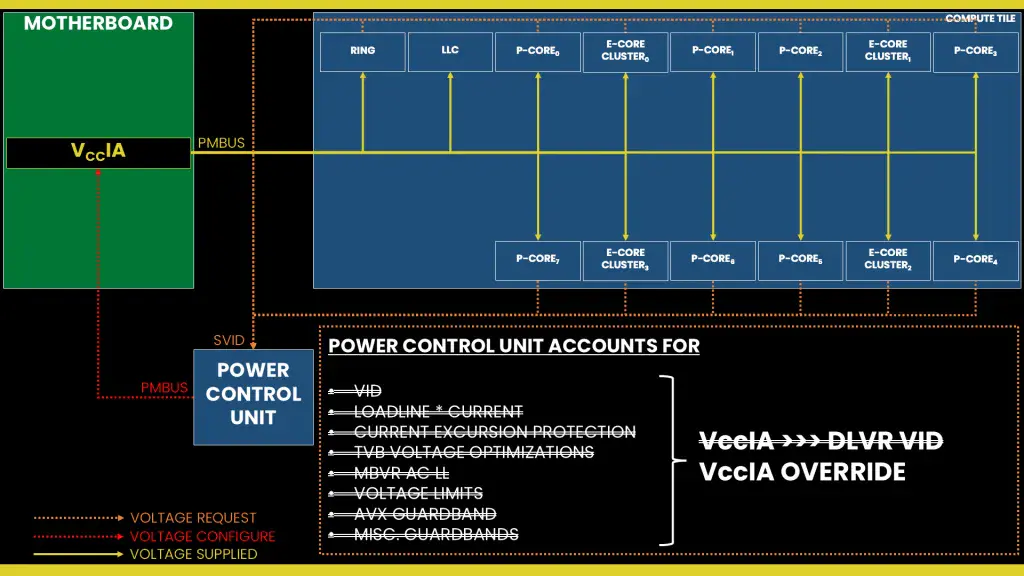
Arrow Lake processors include a power delivery feature called DLVR or Digital Linear Voltage Regulator. In simple terms, it’s an extra step for power delivery path from the VccCore motherboard voltage regulator (MBVR) to the Compute Tile IP blocks, including the P-cores, E-core clusters, and Ring.
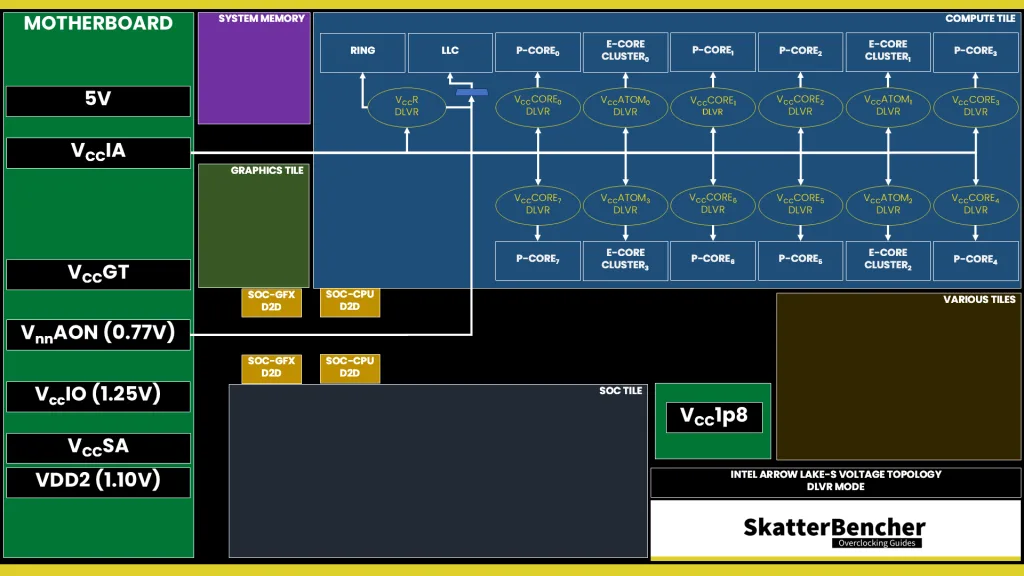
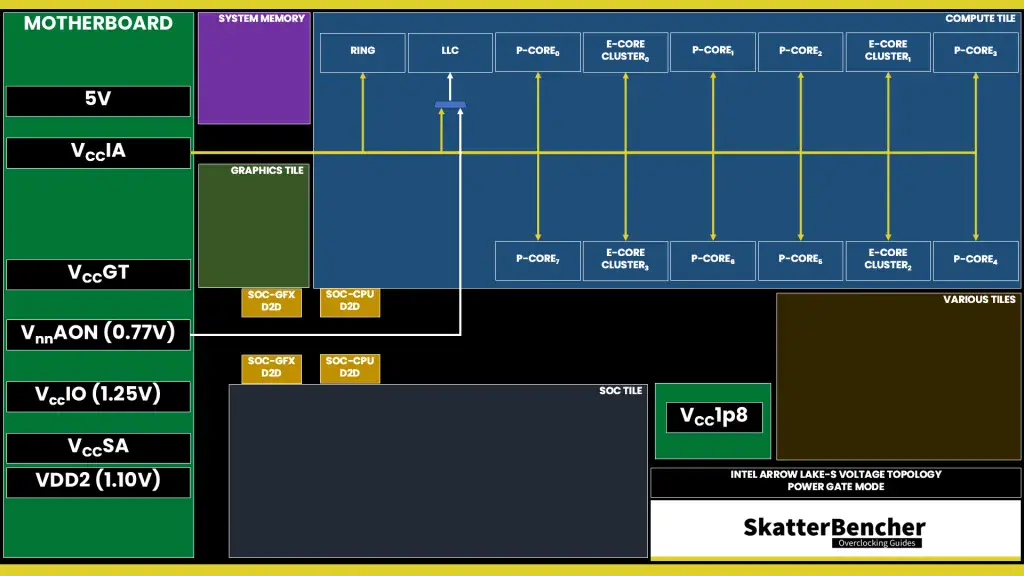
DLVR Bypass, often called “PG Mode” or “Power Gate Mode”, removes that internal stage and powers the Compute Tile IP blocks directly from the VccCore voltage regulator. This overclocking feature was prominently advertised at the launch of Arrow Lake back in 2024 but has since been restricted to extreme cooling only.
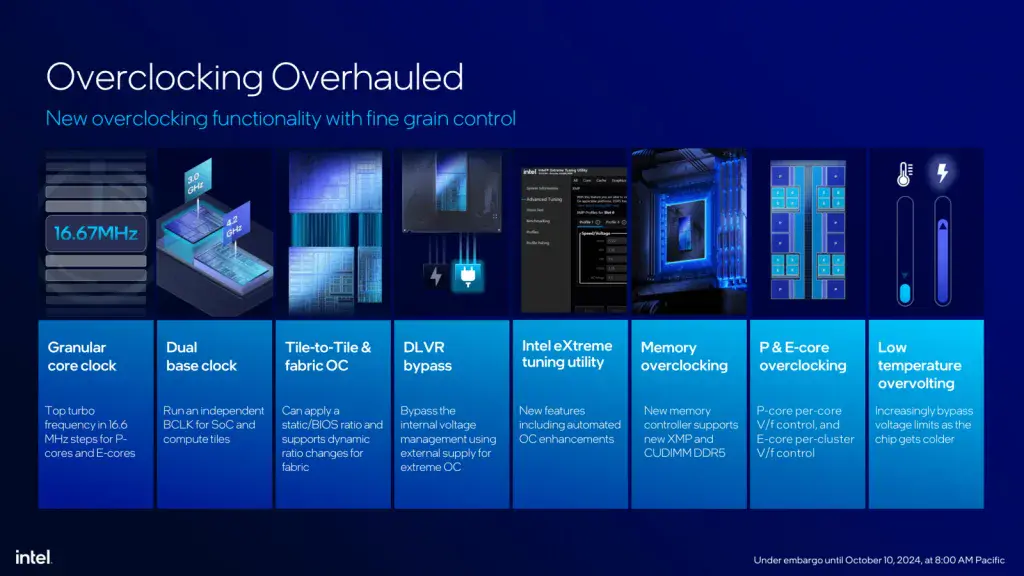
Howvever, until recently PG Mode was still available on some ASUS ROG motherboards despite Intel’s recommendation to remove it. But in newer BIOS versions, it’s now being locked down in line with those guidelines.
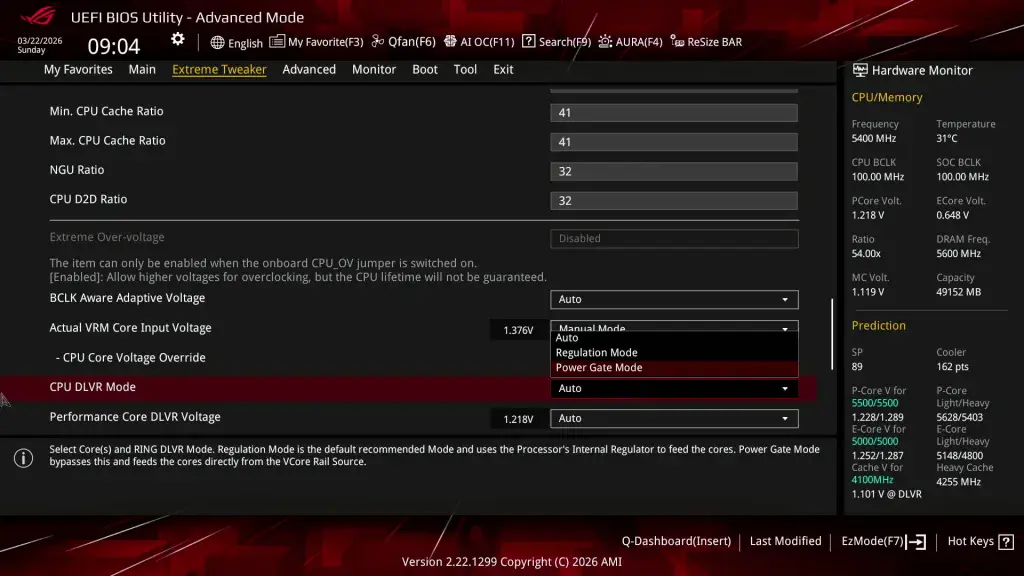
How to Enable DLVR Bypass?
One of the key advantages of DLVR bypass is how straightforward it is compared to tuning with DLVR enabled. Just like with previous platforms, you can set a target voltage for lighter loads, then manage heavy all-core workloads using the VRM load-line.
As an experiment, I tried using DLVR Bypass on the system used in SkatterBencher #101 with the Core Ultra 7 270K Plus. And interestingly, I can almost match the performance of OC Strategy #4 with a fewer BIOS inputs.
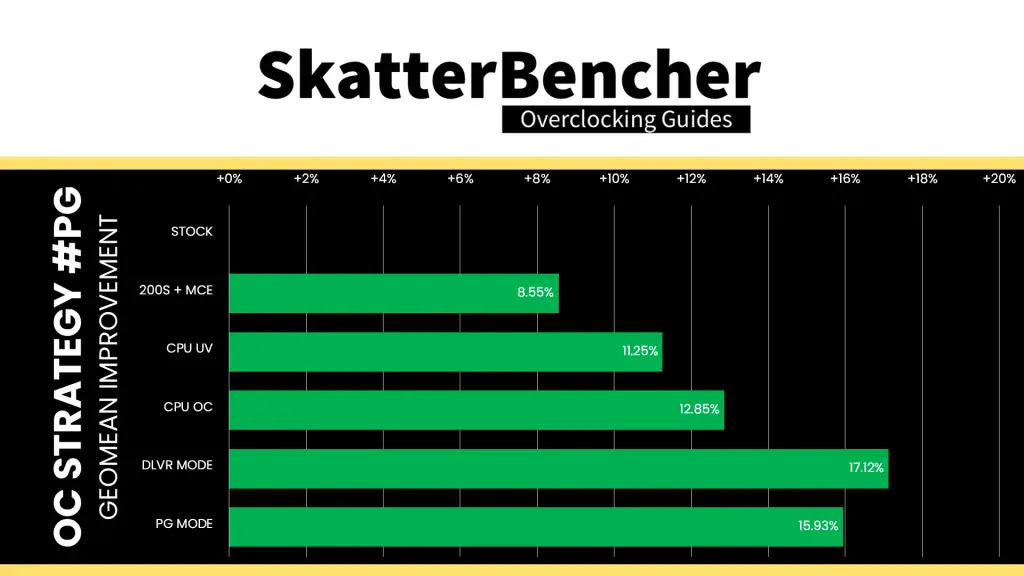
Some overclockers even claim PG Mode offers slightly more headroom. But that’s not really the point.
I’m not here to argue that DLVR Bypass is needed because it gives us better overclocking headroom and the best performance results. My argument is that it doesn’t matter what’s the best approach. What matters is that enthusiasts shouldn’t be locked out of a method. We should be able to try both methods and see what works best for our system.
Why DLVR Bypass for Arrow Lake Enthusiasts Matters
Let’s go through why this matters and why enthusiasts should push for access to DLVR Bypass.
1. It’s better to have it and not need it than need it and not have it
There’s a simple engineering principle: it’s better to have a capability and not need it than to need it and not have it. So even though most users won’t touch the option, for enthusiasts it provides a tool for debugging, experimenting, and performance tuning.
2. Enthusiasts already accept the risk
Enthusiasts buying Intel K-SKU processors and using any of its overclocking functions, whether that’s increasing the Turbo Ratio Limit or adjusting a DLVR adaptive voltage, already implicitly accept the risks associated with overclocking and performance tuning. DLVR bypass isn’t uniquely dangerous compared to what we already do.
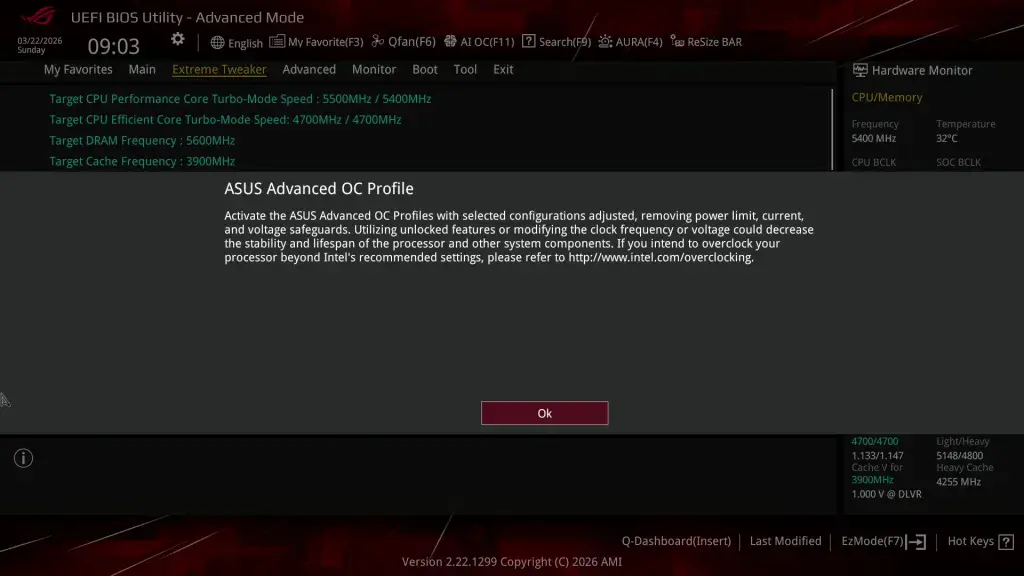
Furthermore, there’s several options that Intel can leverage to have the user explicitly acknowledge the risk of changing settings including a BIOS warning message or even marking a CPU as overclocked on a hardware-level with permanent fuses.
3. Choice is what built the enthusiast platform
A key reason why enthusiasts are drawn to Intel platforms with K-SKU support is depth of control and configuration options. For example, access to CPU ratios, BCLK tuning, subsystem ratios, memory timings, AVX offsets, voltage control, and so much more. DLVR Bypass mode fits perfectly into the Intel K-SKU tradition and philosophy.
4. It improves transparency
DLVR adds a hidden layer inside the CPU but without DLVR bypass, you can’t fully see what’s happening between the motherboard voltage regulator and the CPU cores. However, with PG mode, you can compare with DLVR ON and DLVR OFF. That level of visibility is incredibly valuable for: reviewers, motherboard engineers, detail-oriented enthusiasts, power efficiency research, and so on.
5. Most enthusiasts are not extreme overclockers
Let’s be real: extreme overclockers do not constitute the majority of the overclocking enthusiast scene. They’re a subset of the overclocking community that, admittedly, contributes unique insights and perspective to the enthusiast community by pushing the absolute limits of computer hardware.
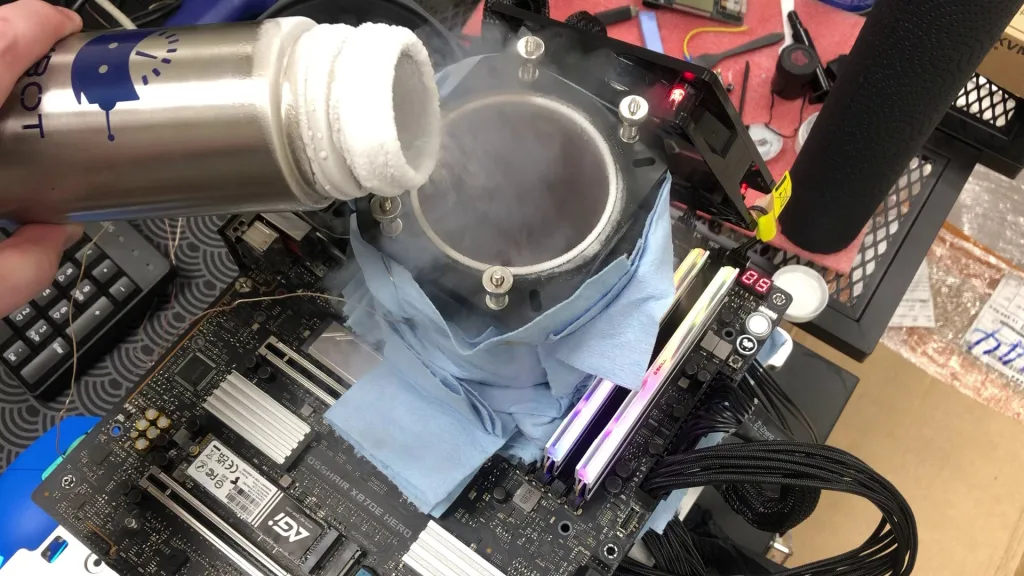
However, most enthusiasts use air cooling, AIOs, or custom water loops. So restricting DLVR bypass to only extreme cooling scenarios removes it from the people most likely to use it on a daily basis.
6. It can improve heavy-load performance
DLVR introduces another stage in the power delivery network from the motherboard voltage regulator to the CPU cores. Therefore, it may introduce additional power losses especially in high-current all-core workloads. The power loss translates into additional heat which is a problem if you’re thermally constraint like most regular enthusiast are.
Enabling the DLVR Bypass option at least gives you options to optimize efficiency for your specific system and workload, and potentially improve the sustained performance.
7. Enthusiasts drive platform visibility
The performance tuning enthusiast community contributes a lot to the industry as a whole with technical analysis, platform validation, performance path-finding, online visibility, and so on. It’s like a crowd-sourced open research group that researches means to achieve highest possible performance or efficiency of a given CPU architecture.
Many insights about Intel CPUs come from independent testing and research. Restricting access reduces the ability to study and understand its architecture, placing the burden of such research on the Intel workforce and the limited folks with special access.
8. BIOS warnings solve the problem
If the concern is misuse, the solution already exists: make it an opt-in feature that requires explicit approval from the user. You can use warnings like “This setting may damage your processor and void warranty,” which most motherboards already provide for voltage overrides, thermal protection changes, and so on.
The argument in favor of providing DLVR Bypass to regular enthusiasts isn’t demanding it’s available by default or part of the official specification. We argue that the option should be available for us to try. Just like any other performance tuning option.
9. Artificial limitations frustrate enthusiasts more than anything
Performance tuning enthusiasts love exploring the limits of their computer chips. For this relentless pursuit of performance, they rely on firmware and hardware tools developed by engineers working at the hardware manufacturers.
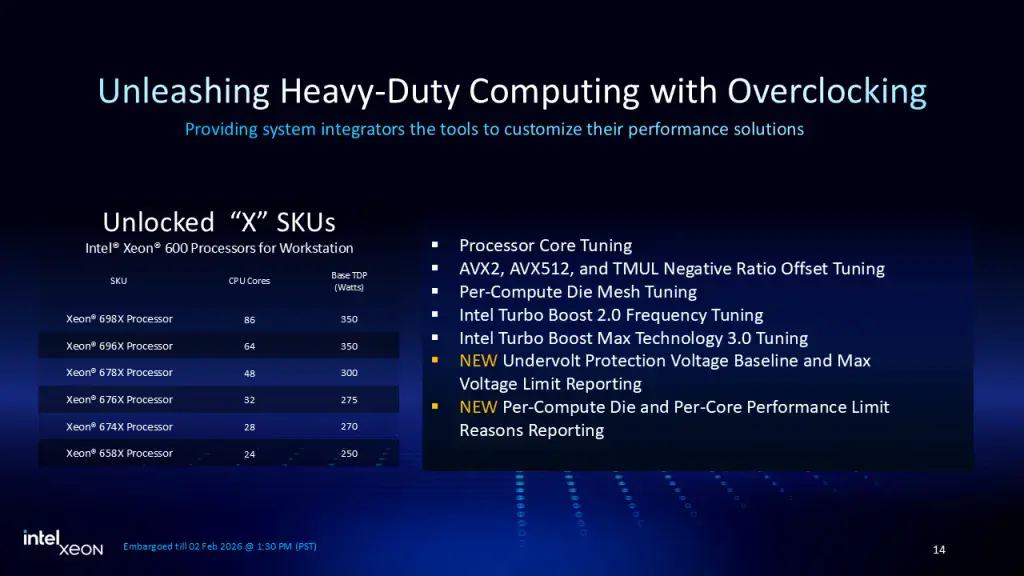
The best-case scenario is that those tools allow us to find the physical limits of the chip. However, often we find that the bottleneck is an artificially imposed limitation due to tools lacking the required configuration range or lacking tools altogether. This frustrates enthusiasts because it gives them the feeling there’s performance left on the table.
But nothing is more frustrating to enthusiasts than a tool that was once there, but is now removed. Because users know that the hardware supports it, that it used to be available, and that it’s intentionally blocked. It creates frustration and reduces trust in the platform.
10. Choice and control define the PC DIY philosophy
One of the defining traits of the PC DIY ecosystem that sets it apart from substitutes is control and customization. This philosophy has enabled thousands of businesses around the world to make products for customers who wish to make the PC experience their own, whether that’s reducing noise, improving thermals, maxing out performance, optimizing power-efficiency, improving stability, minimizing latency, and so on.
DLVR Bypass – just like many of the other overclocking and performance tuning tools and technologies – perfectly aligns with this philosophy.
Conclusion
The bottom line is that I believe enthusiasts should always argue in favor of getting more performance tuning tools regardless of their usefulness for tuning a specific chip. The last thing we need is slowly having tuning tools removed from our toolbox, because we very well know that once its removed it’s hard to get it back.
We’re not asking Intel to encourage or recommend DLVR Bypass for performance tuning, let alone approving motherboard partners to enable it by default. By all means, make it as explicit as needed that DLVR Bypass is an advanced tool, may damage your chip if misused, and most definitely voids warranty.
But when all is said and done, let US evaluate the risk and let US make the decision. That’s the enthusiast way that gives spice, color, and freedom to the PC DIY ecosystem.